



A research team led by Prof. YIN Huajie at the Institute of Solid State Physics, Hefei Institutes of Physical Science, Chinese Academy of Sciences, has developed a flow-field design that improves mass transport in electrocatalytic systems operating at high current densities.
The study was published in Nature Communications.
As electrocatalytic reactions run at higher current densities, it becomes harder to supply enough reactants to the electrode and remove the products. The supply of reactants near the electrode surface can become limited, while products can build up and slow the reaction. In conventional porous electrodes, randomly arranged pores make it difficult to control the flow of liquids through the electrode.
In this study, the researchers developed a hierarchical ordered interconnected porous nickel electrode, known as hOPN. The electrode contains a highly organized three-dimensional pore network that allows liquids and reactants to move more efficiently through the structure. The team also demonstrated that the electrode could be fabricated as a self-supporting structure with an area of up to 100 cm2.
Compared with conventional porous electrodes, the ordered pore design improved mass transport inside the electrode. Under the tested conditions, the mass-transfer coefficient of hOPN was about 17 times higher than that of a disordered porous electrode and 50 times higher than that of nickel foam.
The improved transport properties also enhanced performance in several electrochemical applications. A NiFe-modified hOPN electrode reached a current density of 7 A cm⁻² for the oxygen evolution reaction. In an anion exchange membrane water electrolyzer, the electrode achieved 1 A cm-2 at 1.68 V and remained stable for more than 1,000 hours.
The researchers also built a lightweight, flexible water electrolysis device based on hOPN, which maintained stable operation under fluctuating solar power conditions.
The findings show how controlling the flow of liquids through an electrode can help improve performance in high-current-density electrochemical systems, according to the team.
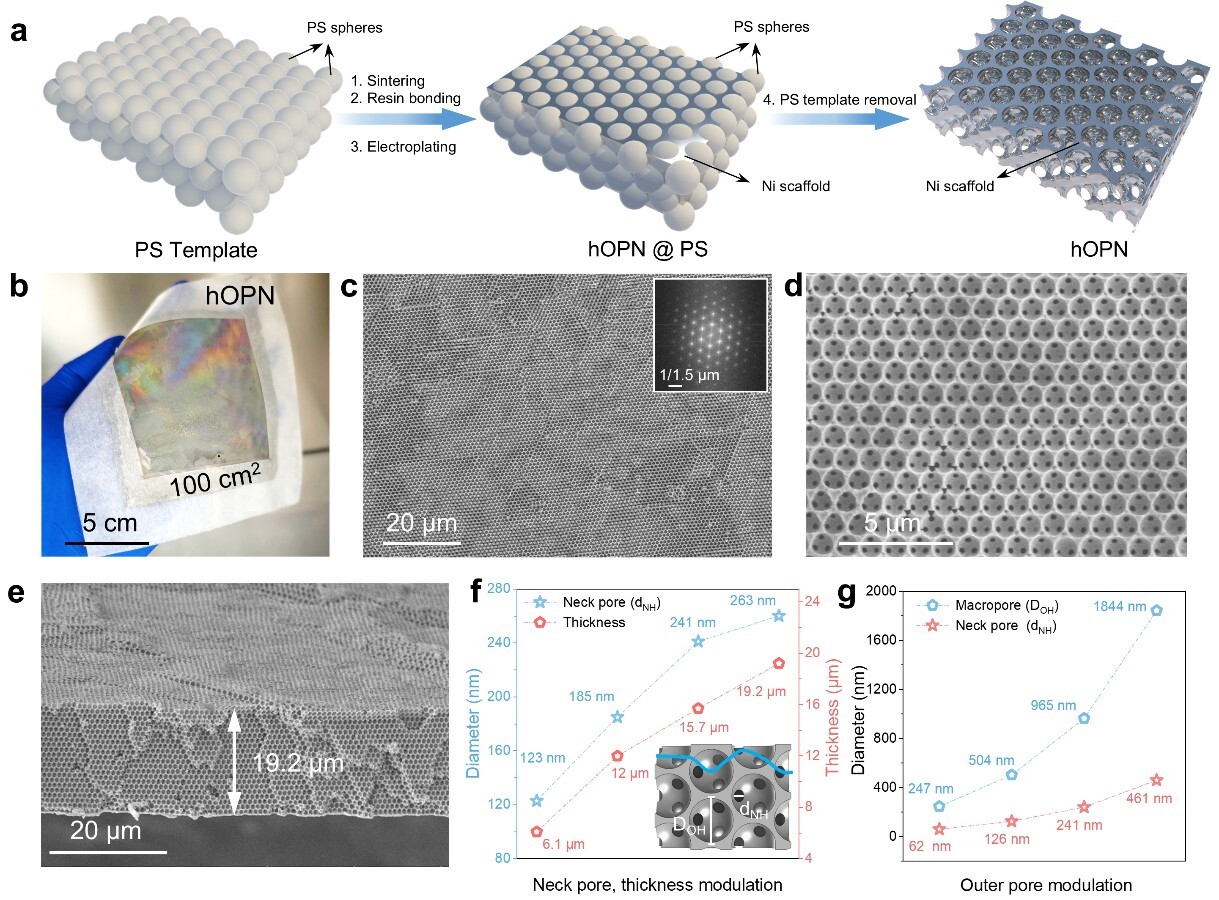
Fabrication and structure of the hierarchical ordered interconnected porous nickel electrode. (Image by YIN Huajie)