
A research team led by Prof. WANG Guozhong from the Hefei Institutes of Physical Science of the Chinese Academy of Sciences, has developed a nickel-doped manganese-based Prussian blue analogue/carbon nanotube composite electrode for hybrid capacitive deionization (HCDI).
The findings were published in Journal of Materials Science & Technology.
HCDI offers a low-energy approach to brackish water desalination and hard water softening. However, manganese-based Prussian blue analogues (MnHCF) have limited electrical conductivity and can become less stable as their structure changes during repeated ion insertion and extraction.
To improve the material, the researchers introduced nickel into the MnHCF structure and incorporated carbon nanotubes (CNTs). The nickel formed Ni–N bonds within the material, helping to maintain its structure and facilitate ion transport. At the same time, the CNTs formed a conductive network that improved electron transport and helped reduce structural changes during repeated cycling.
The team prepared the MNHCF@CNT composite electrode through a one-step co-precipitation process. The electrode showed good desalination performance and maintained 98.72% of its capacity after 40 cycles. It also preferentially removed Ca²⁺ and Mg²⁺, indicating its potential for hard water softening.
The study demonstrates a practical way to improve the stability and desalination performance of MnHCF-based electrodes, with potential applications in water treatment.
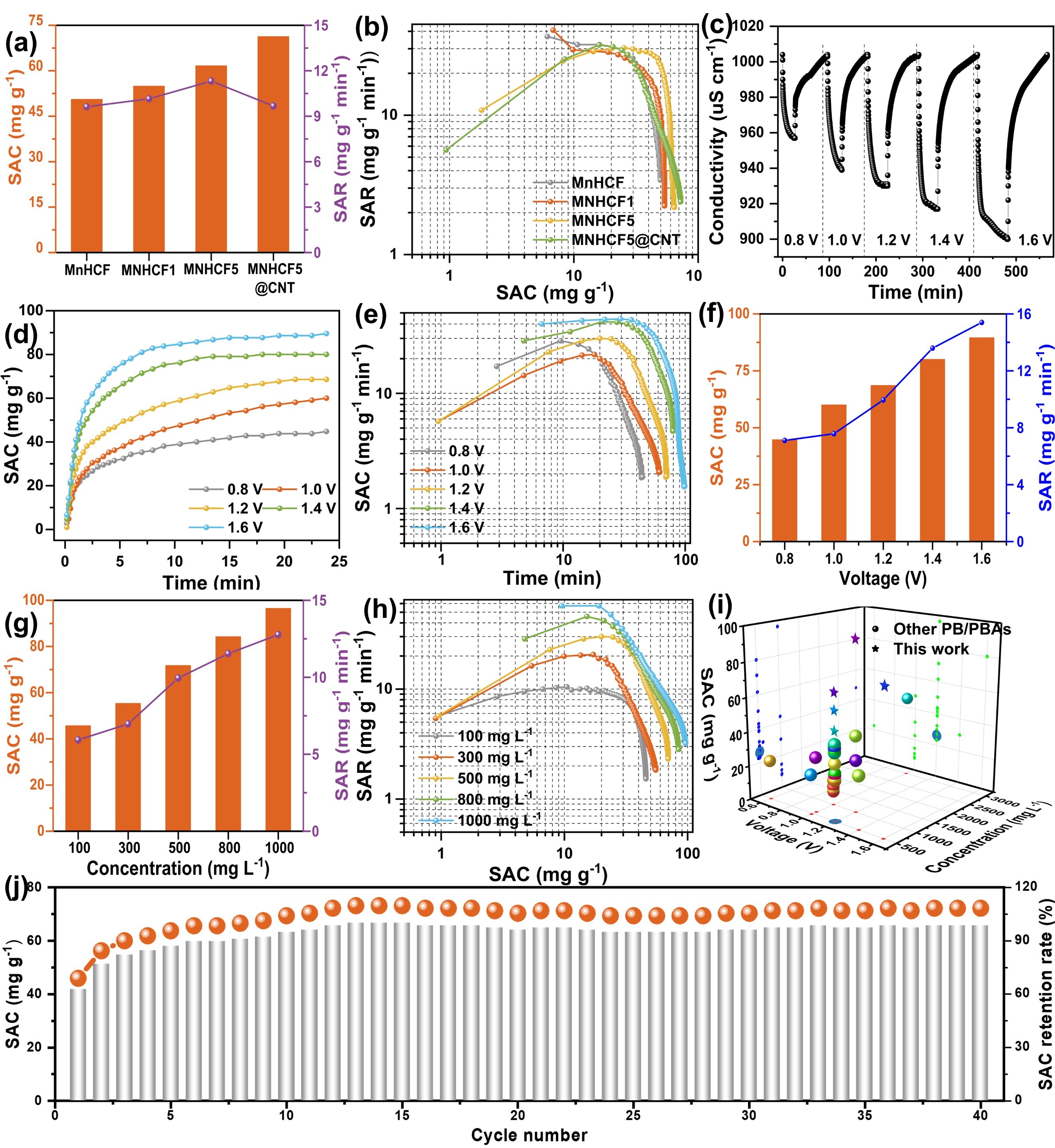
HCDI desalination performance of MNHCF@CNT. (Image by TANG Qi)