



A research team led by Prof. WU Xuebang from the Hefei Institutes of Physical Science of the Chinese Academy of Sciences have discovered that irradiation-induced defects can drive nearby atoms in silicon carbide (SiC) to rearrange and form a local "core-shell" structure at the atomic scale.
The finding helps explain how radiation damage changes the structure and properties of SiC, a material considered for use in advanced nuclear energy systems.
The results were published in the Journal of the European Ceramic Society and Transactions of Materials Research.
SiC is considered a promising material for nuclear energy systems because it can withstand high temperatures and radiation. However, high-energy irradiation can create defects such as vacancies and helium atoms, which may gradually accumulate and change the material' s properties.
In this study, the team combined ion irradiation experiments with first-principles calculations to examine how defects affect SiC at the atomic scale. The results showed that the influence of a defect extends beyond the atoms directly around it.
The atoms closest to the defect may lose stable bonding, while some surrounding atoms can rearrange and form stronger bonds during structural relaxation. As a result, the defect area becomes a relatively unstable "core", surrounded by a region with stronger bonding, creating a quasi-core-shell structure.
The team found similar effects for different types of defects, including helium atoms, vacancies and transmutation elements. The calculations also showed that these defects modify the electronic environment of nearby atoms.
Previous studies by the team on graphite and graphene showed that removing atoms could bring neighboring atoms closer and modify local bonding. In SiC, however, the interaction between silicon and carbon atoms leads to a more complex response, with weakened bonds near the defect and stronger Si-C bonds in the surrounding region.
"Defects can affect atoms beyond their immediate surroundings," said Dr. HUI Jun, a member of the team. "This helps us better understand how radiation damage develops in SiC over time."
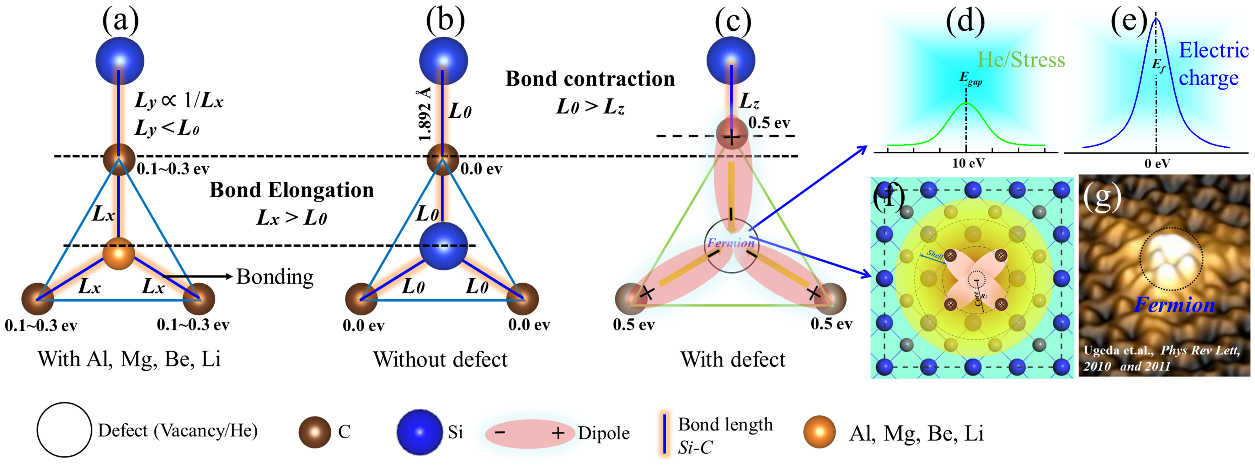
Bond contraction and Fermi level in SiC induced by vacancies or He. (Image by HUI Jun)
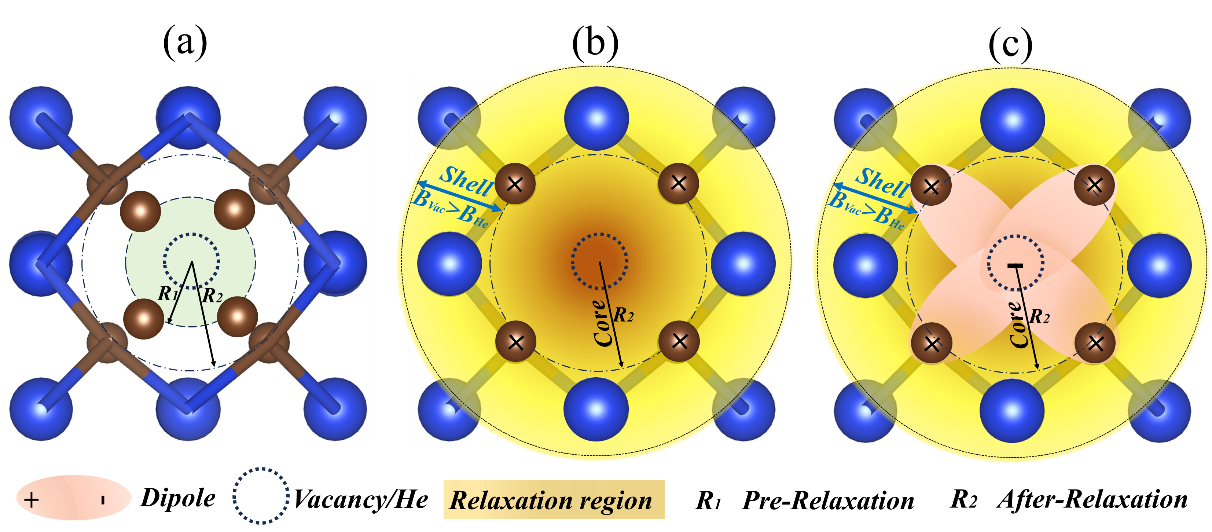
Dynamic process of dipole formation involving He and vacancies. (Image by HUI Jun)
