Recently, a research team led by associate professor LI Xiangyan from the Institute of Solid State Physics, Hefei Institutes of Physical Science (HFIPS), Chinese Academy of Sciences, has uncovered how nano-voids evolve under irradiation and proposed a strategy to reduce helium damage in fusion reactor materials.
The findings were published in Tungsten and Nuclear Fusion.
Fusion reactor structural materials are exposed to intense neutron irradiation, which can generate defects such as nano-voids, leading to swelling, hardening, and creep. Neutron reactions also produce helium in structural materials, where it can accumulate and form bubbles. Grain boundaries can trap helium, but the trapped helium may build up over time and damage the material.
In this study, the researchers first developed a computational framework based on the differential evolution algorithm to explore the stable structures of nano-voids. The simulations showed that small nano-voids tend to form compact polyhedral structures, while larger ones develop faceted shapes surrounded by low-energy surfaces such as (110) and (100).
The team also found that vacancies around nano-voids have different energy levels depending on their local atomic environments. Based on these findings, the researchers linked the energy levels of nano-voids with their atomic structures, helping explain differences in their stability and migration behaviors.
The researchers then examined whether some grain boundaries could help helium move out of the material. Through high-throughput calculations and object kinetic Monte Carlo simulations, the researchers found that some grain boundaries with suitable atomic structures can serve as rapid helium diffusion channels. When connected to free surfaces, these boundaries can help release helium from the material. Similar behaviors were both observed in iron and tungsten.
Based on these results, the researchers proposed a "capture-transport-expulsion" strategy, providing a theoretical basis for using grain-boundary engineering to shift from passive helium capture toward active helium removal and thereby improve the resistance of fusion reactor materials to helium-induced damage.
"By understanding how these defects form and evolve, we hope to provide useful guidance for developing fusion materials with better radiation resistance," said Li Xiangyan, an associate professor of HFIPS.

Ground-state structures, energetic properties, and the linear discrete model for nano-voids in iron. (Image by Li Xiaolin)
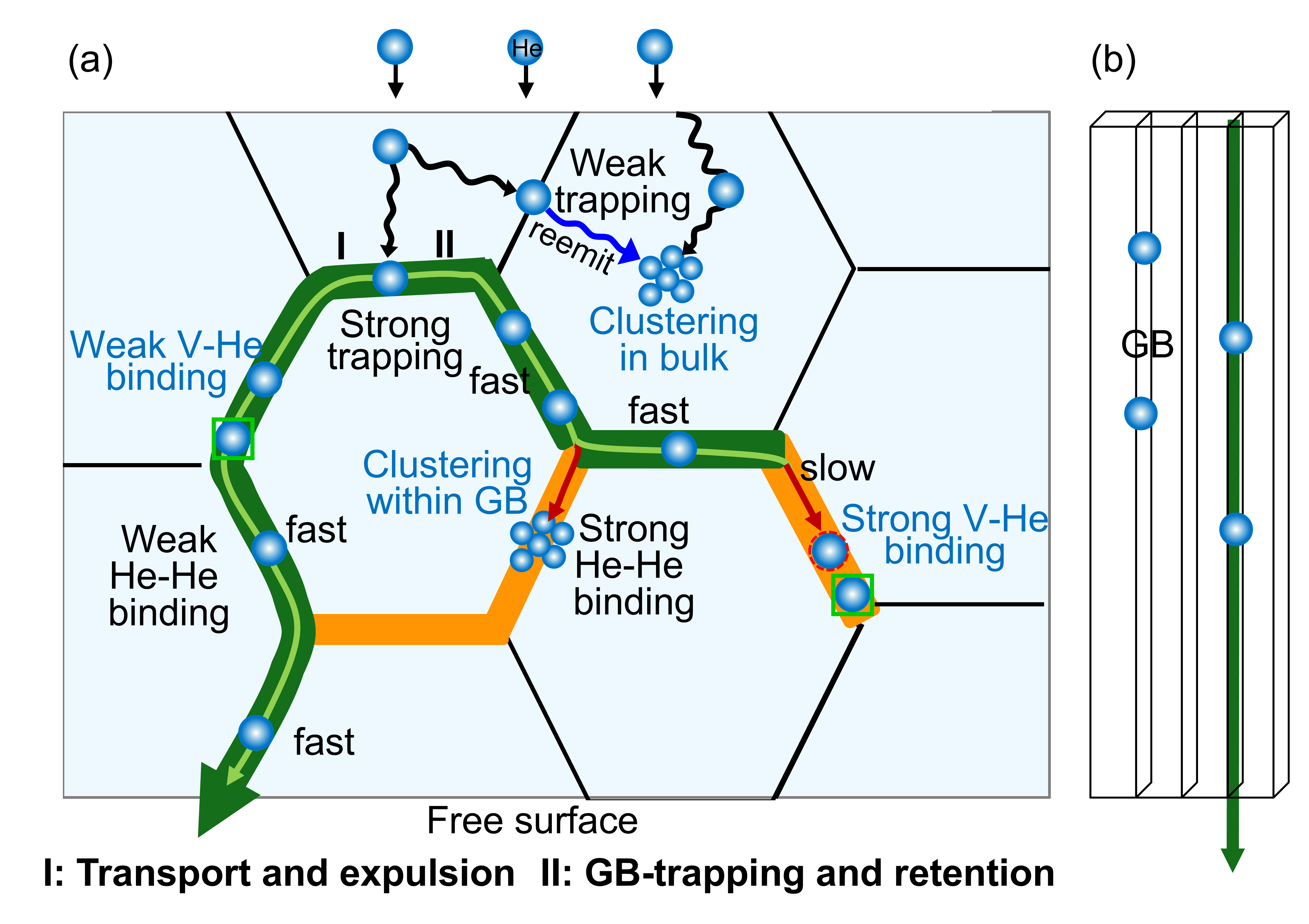
Schematic of the competing mechanisms of helium transport and expulsion in nanocrystalline metals, including the grain-boundary-assisted transport-expulsion and trapping-retention regimes. (Image by Li Xiaolin)