A research team led by Prof. YANG Yong from the Institute of Solid State Physics, Hefei Institutes of Physical Science of the Chinese Academy of Sciences, has predicted new phases of tantalum pentoxide (Ta2O5), and revealed how temperature, pressure, and nuclear quantum effects influence its phase stability.
The related studies were published in Chinese Physics B and Physical Review B.
Ta2O5 is a widely studied wide-bandgap transition metal oxide semiconductor with excellent dielectric and optical properties and good chemical stability. Despite decades of research, its crystal structure and phase behavior remain unclear due to challenges in obtaining high-quality single crystals and the strong influence of synthesis conditions.
In a series of studies, the team investigated the crystal structures and phase transitions of Ta2O5 using first-principles calculations and structure-search methods.
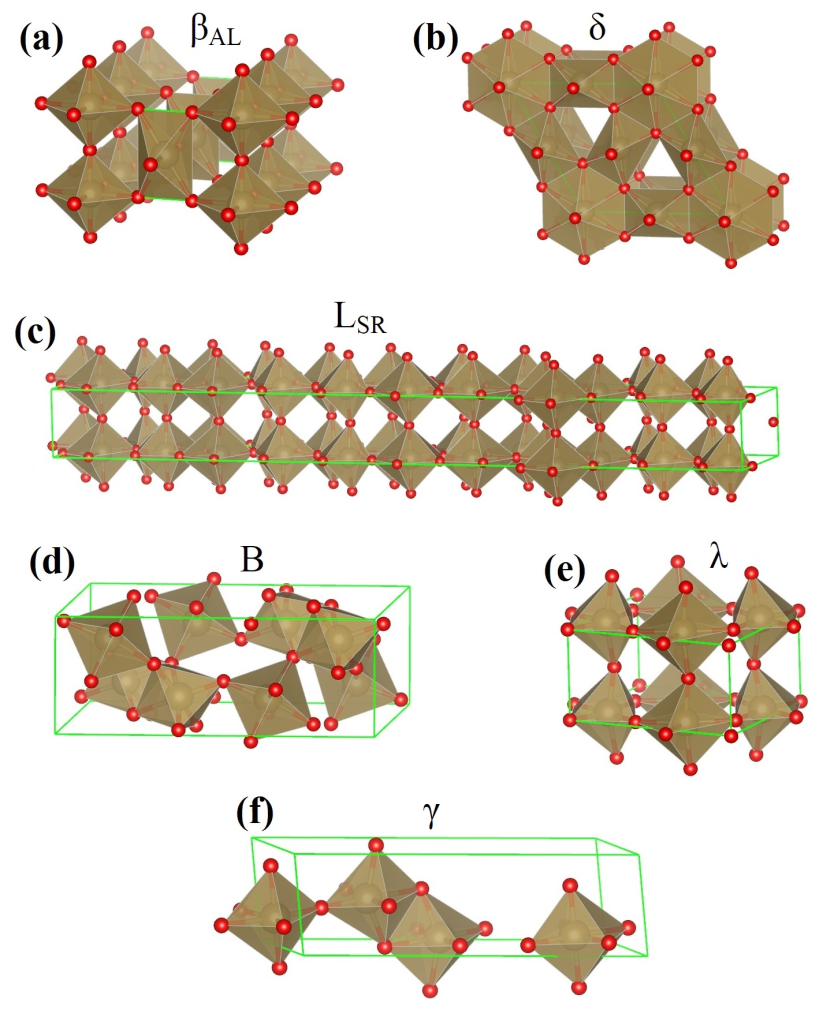
Two low-temperature phases, γ-Ta2O5 and γ₁-Ta2O5, were predicted under ambient pressure, along with a new high-pressure phase, Y-Ta2O5. The calculations showed that the two low-temperature phases are among the most stable ambient-pressure structures reported so far. They also revealed that B-Ta2O5, a previously reported monoclinic phase, transforms into the orthorhombic Y-Ta2O5 phase at about 62 GPa.
By combining first-principles calculations with thermodynamic analysis, the team established a phase diagram which spans a broad range of temperature and pressure, revealing the stability ranges and transformation pathways of different phases of Ta2O5 under varying conditions.
Further analysis showed that nuclear quantum effects can influence the stability of different Ta2O5 phases as well as how they transform under pressure. At around 2 GPa, the calculations predicted a possible reentrant phase transition between γ-Ta2O5 and B-Ta2O5, revealing more complex phase behavior of Ta2O5 under pressure.
In addition, the study identified a characteristic temperature, T0, at which the contributions of zero-point vibrations and thermally excited phonons to the free energy become comparable. The value of T0 was found to be about one third of the Debye temperature.
These findings provide an in-depth understanding of the structural evolution and phase transitions of Ta2O5 under varying conditions.
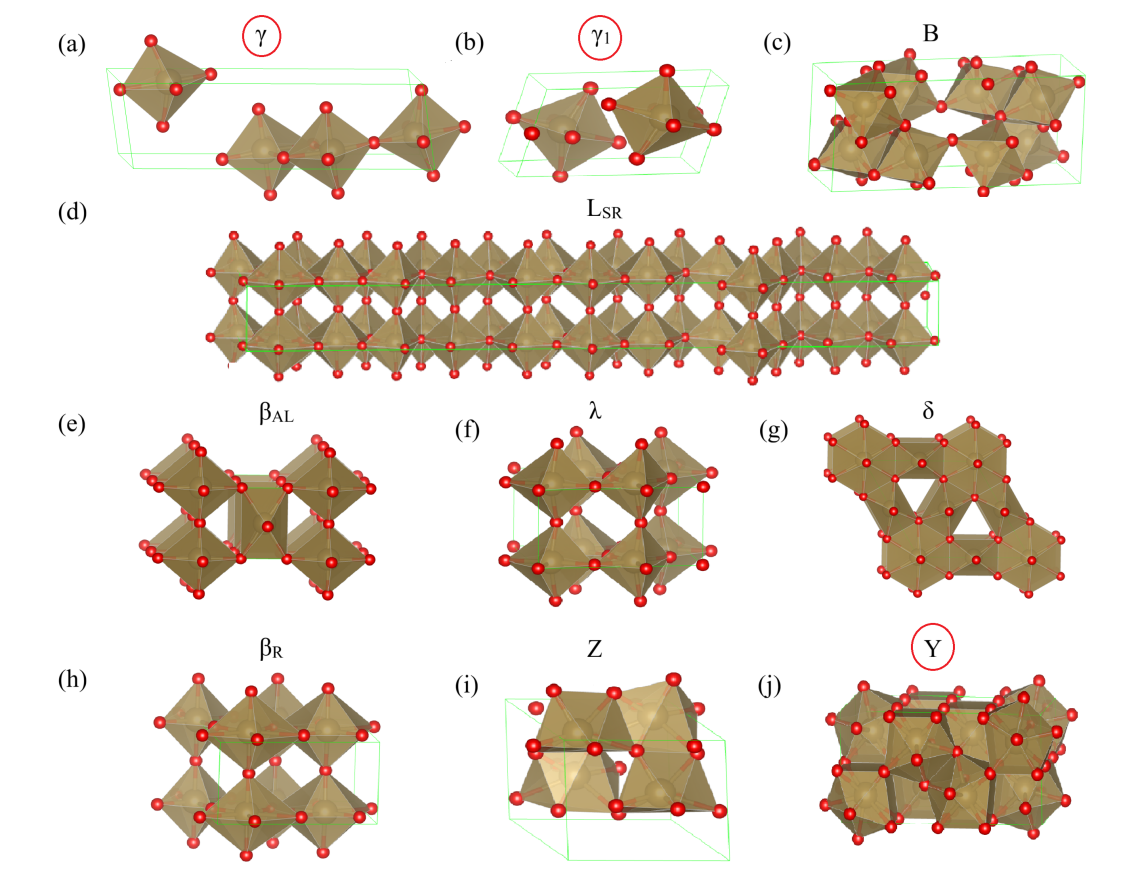
Ten crystal structural models of Ta2O5, among which the γ, γ1 and Y phase are structures predicted by the team. (Image by YANG Yong)