



Researchers at the Hefei Institutes of Physical Science of the Chinese Academy of Sciences, have developed a new theoretical framework for understanding the neoclassical transport of high-Z tungsten impurities in tokamak plasmas.
The study, led by Prof. PAN Chengkang, identified how the poloidal asymmetry of lower-Z impurities can alter tungsten transport.
The findings were published in Nuclear Fusion.
Tungsten is widely used in tokamaks because of its high melting point and resistance to erosion. However, tungsten impurities can build up in the plasma core and cause radiation losses, making their transport an important issue for fusion research. Other impurities are also present in tokamak plasmas, and lower-Z impurities are often introduced to improve plasma performance and reduce heat loads on divertor targets. Experiments have shown that they can also affect tungsten transport, but the mechanism behind this effect remains unclear.
In this study, the researchers extended their theoretical model of tungsten neoclassical transport to include the effects of lower-Z impurities. Their analysis showed that these impurities can alter tungsten transport. In particular, the traditional dependence of tungsten transport on the radial gradients of bulk-ion density and temperature no longer holds in the same way.
The researchers found that the poloidal asymmetry of lower-Z impurities plays a key role in altering tungsten transport. They also identified the conditions under which this effect becomes dominant and established a critical value of the bulk-ion radial gradient, (R/LnT)cri.
When the radial gradient exceeds this critical value, tungsten neoclassical transport increases with the concentration of lower-Z impurities, while below the threshold, it decreases as the concentration of lower-Z impurities increases.
The results suggest that conventional models of tungsten neoclassical transport may not fully capture the effects of coexisting lower-Z impurities, potentially leading to deviations in transport estimates.
The study provides a more detailed picture of how impurity species interact in tokamak plasmas and may help improve the assessment and control of tungsten transport, according to the team.
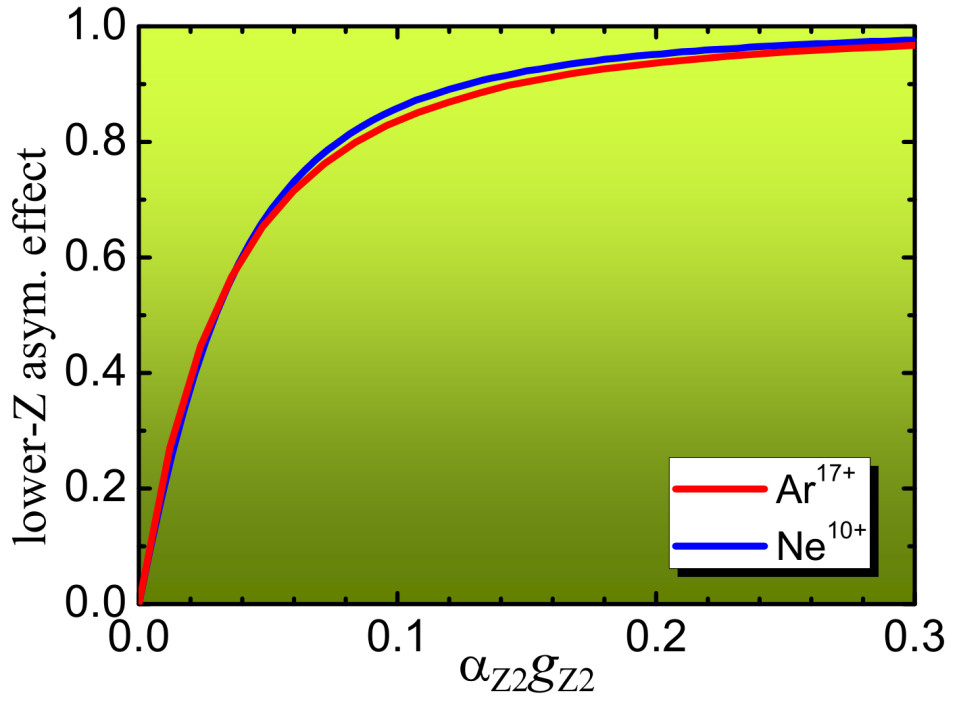
The contribution of the lower-Z impurity poloidal asymmetry effect on the Tungsten neoclassical transport. (Image by PAN Chengkang)