



A research team led by Prof. LIU Qingsong from Hefei Institutes of Physical Science, Chinese Academy of Sciences, has developed a new small molecule that attacks pancreatic cancer cells in two ways and may help improve the effectiveness of chemotherapy.
The compound, called IHMT-140, targets discoidin domain receptor 1 (DDR1), a protein involved in how pancreatic cancer cells interact with and remodel collagen around tumors. The researchers found that IHMT-140 not only blocks this process, but also triggers a form of cell death in cancer cells.
The study was published in the Journal of Advanced Research.
Pancreatic cancer is one of the most difficult cancers to treat. One major challenge is the dense tissue surrounding pancreatic tumors. Rich in collagen, this tissue can make it difficult for drugs to reach cancer cells and can also keep immune cells out of the tumor.
In this study, researchers found that IHMT-140 works in two ways. First, it blocks DDR1, reducing collagen production and slowing the spread of pancreatic cancer cells.
Second, IHMT-140 makes cancer cells take in more material from their surroundings. This causes large bubbles to build up inside the cells and eventually kills them. At the same time, the increased uptake allows the cells to take in more gemcitabine, a commonly used chemotherapy drug.
In mice, IHMT-140 worked together with gemcitabine to slow tumor growth more effectively than either treatment alone.
The findings show that IHMT-140 may help slow pancreatic cancer growth and make chemotherapy work better, offering a new way to treat the disease, according to the team.
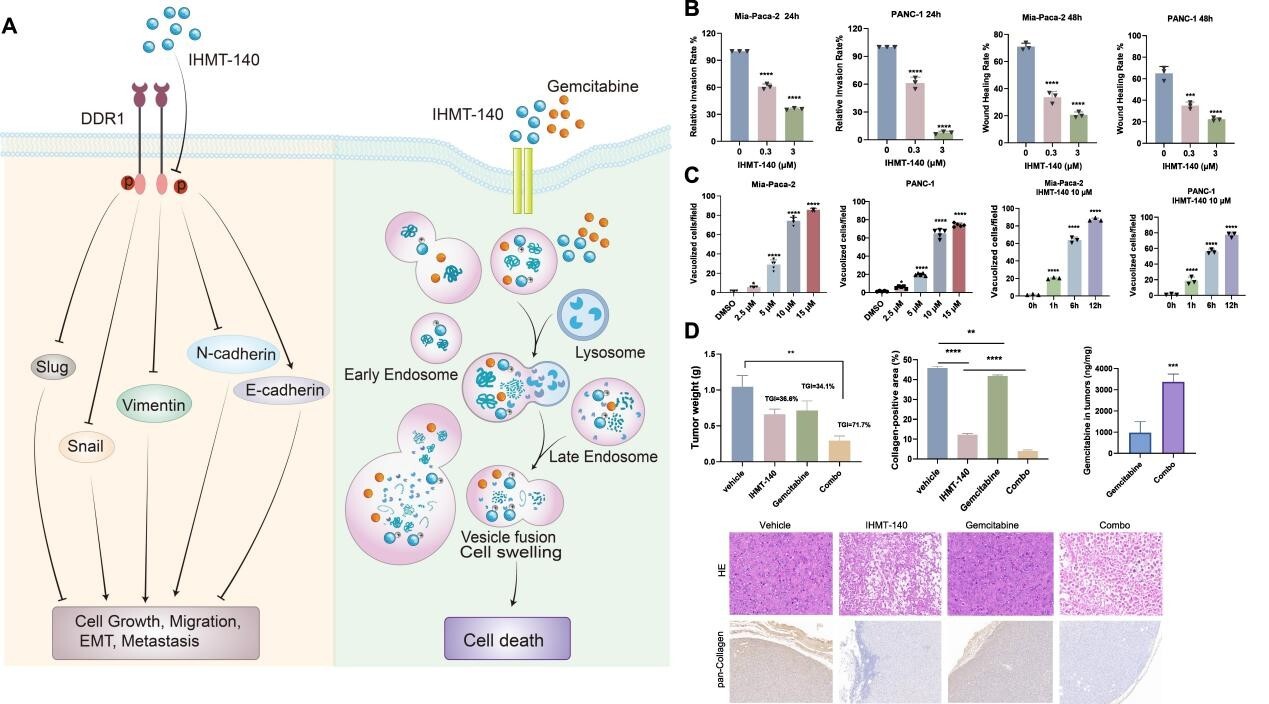
The dual mechanism of action and therapeutic effects of IHMT-140 in pancreatic cancer. (Image by WANG Beilei)