



A research team from the Institute of Health and Medical Technology at the Hefei Institutes of Physical Science, Chinese Academy of Sciences, has developed a standardized workflow for analyzing DNA methylation in individual cells.
Published in Nature Protocols, the protocol combines an improved laboratory procedure with an automated data analysis tool, making it easier to study differences between cells.
DNA methylation helps regulate gene activity and is involved in cell development and disease. Traditional sequencing measures average methylation levels across many cells, potentially masking differences between individual cells. Single-cell sequencing can reveal these differences, but the small amount of DNA in each cell makes sample preparation challenging.
The team simplified several steps in the process. Cell preparation, DNA digestion and other reactions are carried out in the same microwell, reducing the need for repeated purification and helping prevent DNA loss. Molecular barcodes label individual samples, allowing 24 single-cell samples to be pooled for processing. This reduces reagent use and makes the process more efficient.
The researchers also developed an automated analysis tool, SingleCellMethPipe, which processes sequencing data, identifies methylation patterns and checks data quality.
To evaluate the method, the team analyzed 96 individual blood-forming stem and progenitor cells from a healthy donor and a patient with myelodysplastic syndrome, a disorder that affects the production of healthy blood cells. Of these, 86 passed quality checks, giving a success rate of 89.6%. The analysis identified DNA methylation differences between cell types and between the healthy and disease samples.
The protocol provides researchers with a practical tool for studying how cells develop and how changes in DNA methylation are linked to blood disorders and cancer.
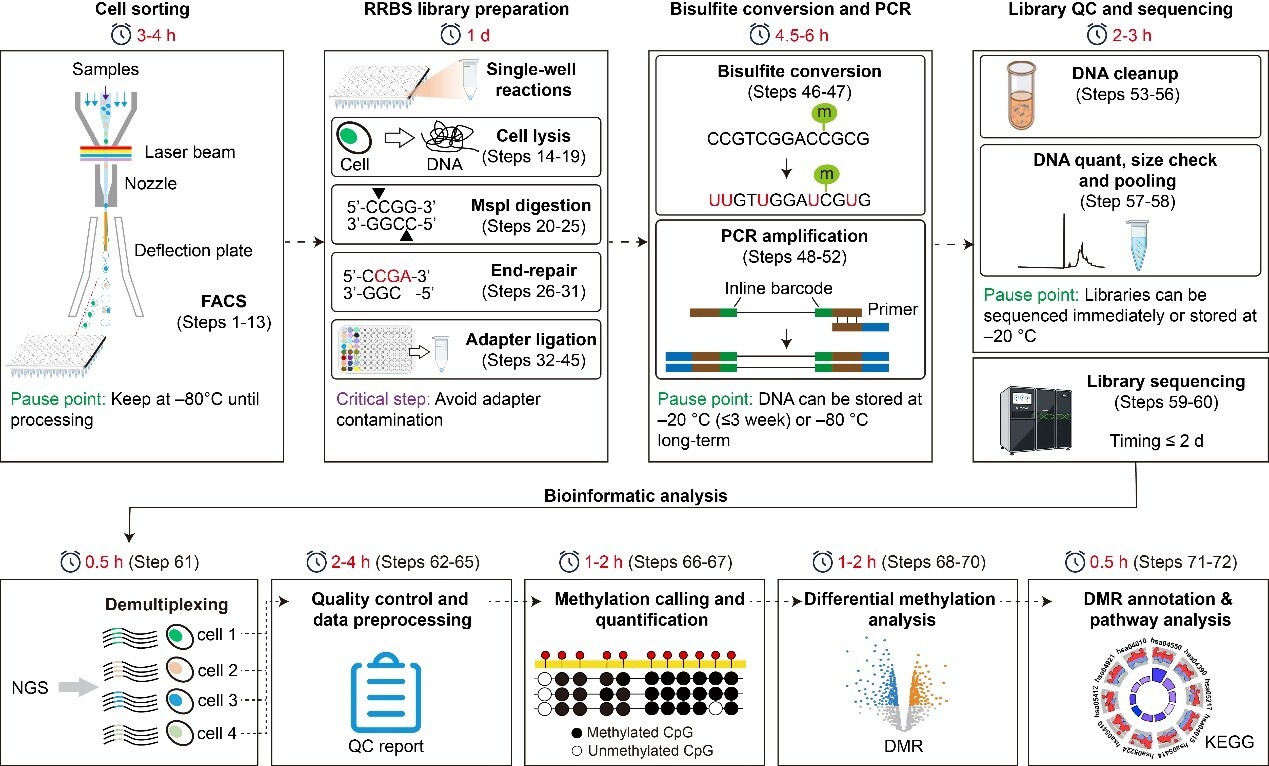
Workflow of Msc-RRBS library preparation and methylation analysis. (Image by GU Hongcang)

