



Researchers from the Hefei Institutes of Physical Science of the Chinese Academy of Sciences, in collaboration with the Key Laboratory of Odor Pollution Control of the Ministry of Ecology and Environment and Shenzhen Technology University, have developed a gas sensor that can detect tiny amounts of dimethyl sulfide in human breath, even in the presence of interfering gases and high humidity.
The findings, published in ACS Nano, could help improve breath-based screening for liver diseases.
Dimethyl sulfide is normally present in breath at low concentrations, but levels above 30 parts per billion (ppb) have been associated with liver conditions such as cirrhosis and hypermethioninemia. Measuring it accurately, however, is not easy. Hydrogen sulfide, another gas commonly found in breath, can interfere with the measurement. High humidity in exhaled breath adds another challenge.
To overcome these problems, the researchers added a thin filtering layer made of copper oxide and aluminum oxide to the sensor. The layer captures hydrogen sulfide before it reaches the sensing material, while allowing dimethyl sulfide to pass through. It also helps reduce interference from moisture.
With this additional layer, the sensor became much better at distinguishing dimethyl sulfide from hydrogen sulfide. Its response ratio for the two gases increased from 3.3 to 50.4, and it could detect dimethyl sulfide at concentrations as low as 10 ppb under 90% relative humidity.
Tests using breath samples designed to simulate those of liver disease patients showed that the sensor could detect small changes in dimethyl sulfide concentrations in complex breath samples.
The results point to the potential of this sensor for noninvasive liver disease screening through breath analysis.
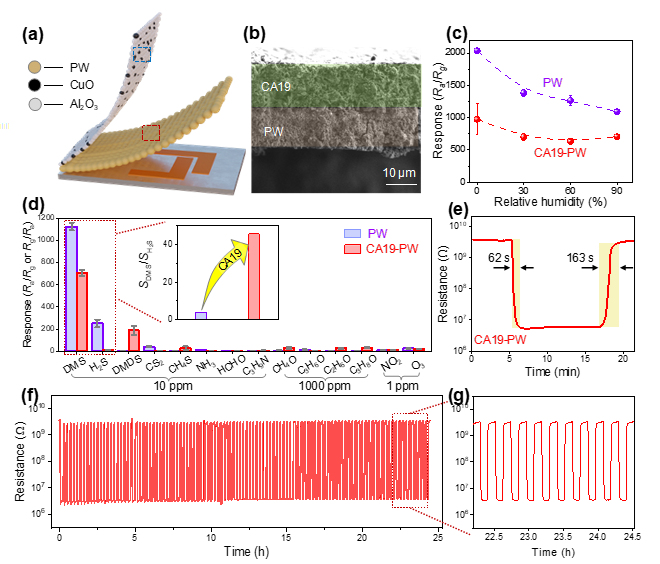
Schematic diagram, Scanning Electron Microscopy image, and gas sensing performances of the sensor (Image by DENG Zanhong)

