



A research team led by Prof. LI Xiangxian from Hefei Institutes of Physical Science, Chinese Academy of Sciences, has developed a machine-learning framework to improve the accuracy of gas measurements when the absorption spectra of different gases overlap.
In collaboration with Liaocheng University and Jiangnan University, the team combined long short-term memory (LSTM), particle swarm optimization (PSO), and support vector regression (SVR) to improve the measurement of carbon monoxide (CO) and carbon dioxide (CO2) under severe spectral interference.
The findings were published in Spectrochimica Acta Part A: Molecular and Biomolecular Spectroscopy.
Monitoring CO and CO2 emissions is important for air quality control and greenhouse gas monitoring. FTIR spectroscopy can measure multiple gases simultaneously, but overlapping absorption signals make it difficult to accurately determine individual gas concentrations. This is particularly challenging for CO and CO2, whose absorption features overlap in the 2210–2250 cm-1 spectral region, especially at high concentrations.
To address this problem, the researchers designed a hybrid framework in which each algorithm plays a different role. LSTM extracts key features from overlapping spectral signals and captures complex relationships between spectral patterns and gas concentrations. SVR uses these features to predict gas concentrations, while PSO automatically optimizes the model's key parameters. Together, the three algorithms help improve prediction accuracy and stability, even when the number of training samples is limited.
The team evaluated the framework using 600 spectra collected from 200 different CO/CO2 concentration combinations. The model achieved root mean square errors (RMSEs) of 19.65 ppm for CO and 20.25 ppm for CO2. Compared with conventional methods, including principal component regression (PCR) and partial least squares regression (PLSR), it reduced prediction errors by more than 88% for both gases. It also outperformed a standard SVR model, reducing errors by 79.84% for CO and 92.74% for CO2.
The model also demonstrated good computational efficiency, processing each spectrum in an average of 3.15 milliseconds after training. This makes the framework a promising tool for rapid and accurate gas analysis, with potential applications in industrial emission monitoring and greenhouse gas measurement.
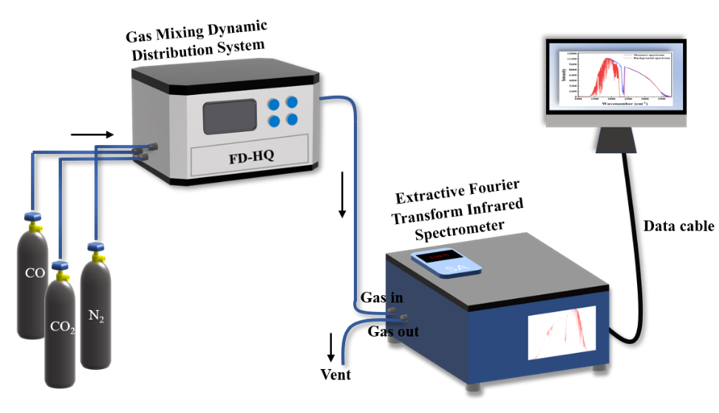
Schematic Diagram of the FTIR Gas Sensing System (Image by ZHAO Tianxiang)