A research team led by Professor JIANG Changlong at the Hefei Institutes of Physical Science, Chinese Academy of Sciences, has developed a highly sensitive, real-time sensor for detecting trace water, addressing key challenges in modern industrial quality control and environmental monitoring.
The research result was published in Chemical Engineering Journal.
Accurate measurement of trace water is crucial for environmental monitoring and quality control in modern industry. However, detecting water at extremely low concentrations (ppb level) is challenging: signals are weak, water’s strong polarity slows sensor response, and performance is easily affected by temperature changes and complex backgrounds. High costs and the complexity of sensitive materials also limit the widespread use of high-performance sensors.
In this study, the researchers employed a one-step hydrothermal synthesis to prepare a MIL-101-NH₂(Eu) metal-organic framework (MOF) with intrinsic dual-color fluorescence. This material avoids interference from other organic solvents and exhibits a fluorescence color change when exposed to trace water, enabling visual detection. Europium ions (Eu³⁺) and BDC-NH₂ ligands in the MOF enhance red fluorescence via the "antenna effect." When water interacts with the ligand, intramolecular charge transfer weakens this effect, revealing the ligand’s blue fluorescence and allowing detection at remarkably low concentrations.
They then combined the MOF with carboxymethyl cellulose to construct a MOFs@cellulose nanofiber membrane sensor through in-situ growth. The resulting sensor demonstrates rapid response, high sensitivity, and visual fluorescence detection of moisture.
To further improve performance, the researchers integrated a deep learning algorithm, enhancing detection accuracy and sensitivity.
This work provides a reliable, cost-effective, and environmentally friendly approach to developing functionalized nanofiber sensors with tunable optical properties, with promising applications in environmental monitoring and smart wearable devices.
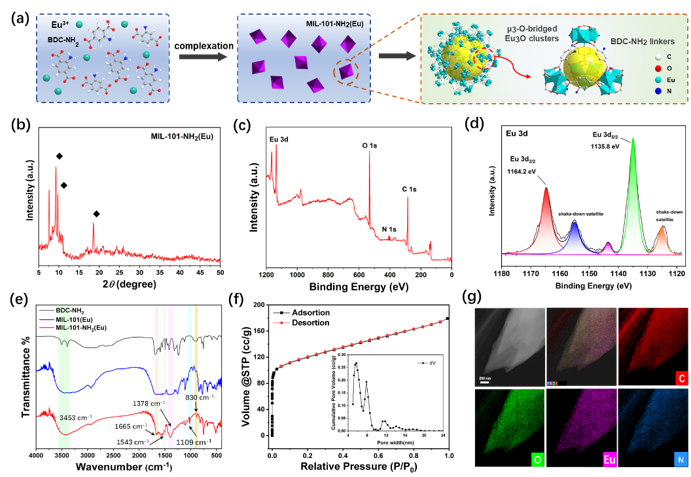
Synthesis route and characterization of lanthanide-based fluorescent MOF materials. (Image by LIN Dan)