Researchers from the Hefei Institutes of Physical Science analyzed 32 years of global ground-based observations from the Aerosol Robotic Network (AERONET) and studied how aerosol optical depth (AOD) changes throughout the day.
Their findings were published in Geophysical Research Letters.
Atmospheric aerosols are tiny particles floating in the air. Changes in AOD reflect rapid shifts in the atmosphere and are closely linked to air quality and climate processes. However, current observations and datasets still face challenges in balancing accuracy with full spatial and temporal coverage.
In this study, using long-term minute-level observations from AERONET, the team identified eight typical patterns of how AOD varies within a day. These patterns have clear physical meaning and are closely related to land surface conditions and aerosol types, suggesting that local environments play an important role in shaping daily AOD behavior.
The researchers also evaluated the performance of current reanalysis datasets and model simulations in reproducing hourly AOD variations. They found that only about 12.7% of the global region can be well represented. Model performance also varies by region: simulations match observations better in the morning over natural landscapes, while in areas influenced by human activity, consistency is higher in the afternoon.
These results may help improve air quality, optimize orbital design for atmospheric monitoring satellites, and climate models,according to the team.
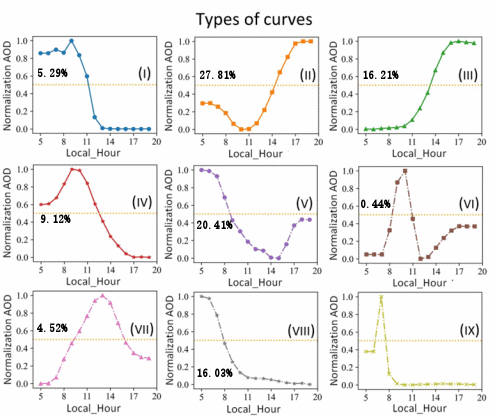
Nine Typical Diurnal Variation Characteristic Curves of Aerosol Optical Depth (AOD) at Global AERONET Stations (Category 9 only represents cases with excessive missing values or outliers in the diurnal variation data) (Image by CHEN Cheng)