



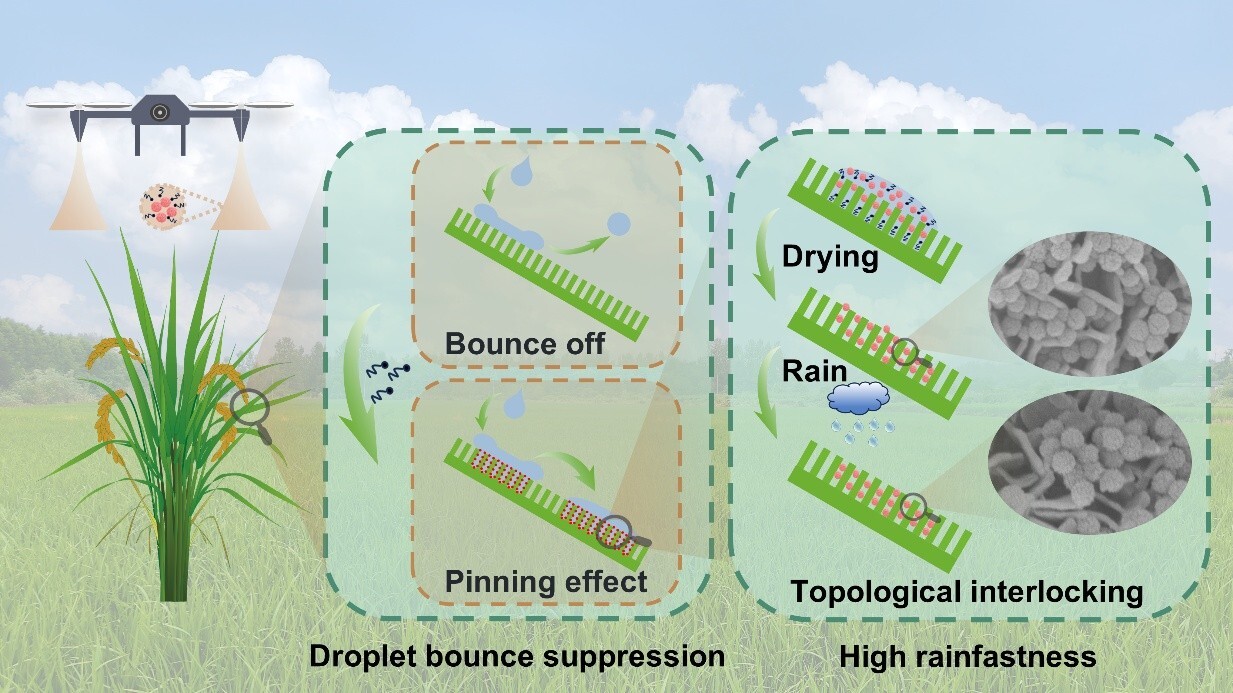
Recently, a research team led by Prof. WANG Guozhong and LI Wenchao from the Hefei Institutes of Physical Science of the Chinese Academy of Sciences, developed a foliar nitrogen fertilizer that helps nanoagrochemicals better stick to rice leaves and resist being washed away by rain.

Researchers led by Prof. MENG Guowen and Prof. TANG Haibin at the Institute of Solid State Physics, Hefei Institutes of Physical Science, Chinese Academy of Sciences, have developed self-supported electrodes that improve the conversion of carbon dioxide into carbon monoxide and n-propanol.

A research team led by Prof. ZHANG Hongwen at the Institute of Solid State Physics, Hefei Institutes of Physical Science, Chinese Academy of Sciences, has developed a portable surface-enhanced Raman spectroscopy (SERS) sensor that can rapidly detect trace amounts of sarin and other organophosphorus (OP) nerve agents.

A research team led by Prof. LI Hai from Hefei Institutes of Physical Science, Chinese Academy of Sciences, has developed an explainable artificial intelligence (AI) approach to assess the risk of central lymph node metastasis in patients with papillary thyroid carcinoma (PTC) before surgery.

A research team led by Prof. YIN Huajie at the Institute of Solid State Physics, Hefei Institutes of Physical Science, Chinese Academy of Sciences, has developed a flow-field design that improves mass transport in electrocatalytic systems operating at high current densities.