A research team led by Prof. WANG Hui from Hefei Institutes of Physical Science, Chinese Academy of Sciences (CAS), in collaboration with Prof. FAN Kelong 's team from the Institute of Biophysics of CAS has developed an iron dual-atom nanozyme with highly efficient catalase-like activity, showing promise for treating rheumatoid arthritis.
The study was published in Angewandte Chemie International Edition.
Nanozymes are artificial materials that mimic natural enzymes. Catalase-like nanozymes can break down hydrogen peroxide (H2O2) and help reduce oxidative stress, but iron single-atom nanozymes often have limited catalytic efficiency.
In this study, the researchers designed the material with two neighboring iron atoms that can work together during catalysis. Using a combination of vacancy induction and electrostatic adsorption, they constructed iron dual-atom active sites and prepared two nanozymes with different nitrogen coordination structures, pr-Fe-DA and py-Fe-DA.
Among them, py-Fe-DA showed particularly strong catalase-like activity. It efficiently decomposed H₂O₂ while continuously generating oxygen. Its specific activity reached 100.13 U mg-1, about 2.4 times that of pr-Fe-DA, highlighting the benefit of having two closely connected iron sites.
Further magnetic characterization and theoretical calculations showed that the nitrogen coordination environment plays an important role in controlling the interaction between neighboring iron atoms. In py-Fe-DA, the iron sites exhibit ferromagnetic coupling, which helps the catalytic reaction proceed along a more favorable pathway. This interaction makes it easier for the material to break down H₂O₂, contributing to its high catalytic efficiency.
The researchers then evaluated py-Fe-DA in a mouse model of rheumatoid arthritis. The nanozyme helped reduce oxidative stress and inflammation and showed a clear therapeutic effect in the model, suggesting its potential for treating rheumatoid arthritis and other conditions associated with oxidative stress.
The study shows that magnetic interactions between neighboring metal sites can improve nanozyme performance, offering a new approach to developing antioxidant nanozymes for rheumatoid arthritis and other oxidative stress-related diseases.
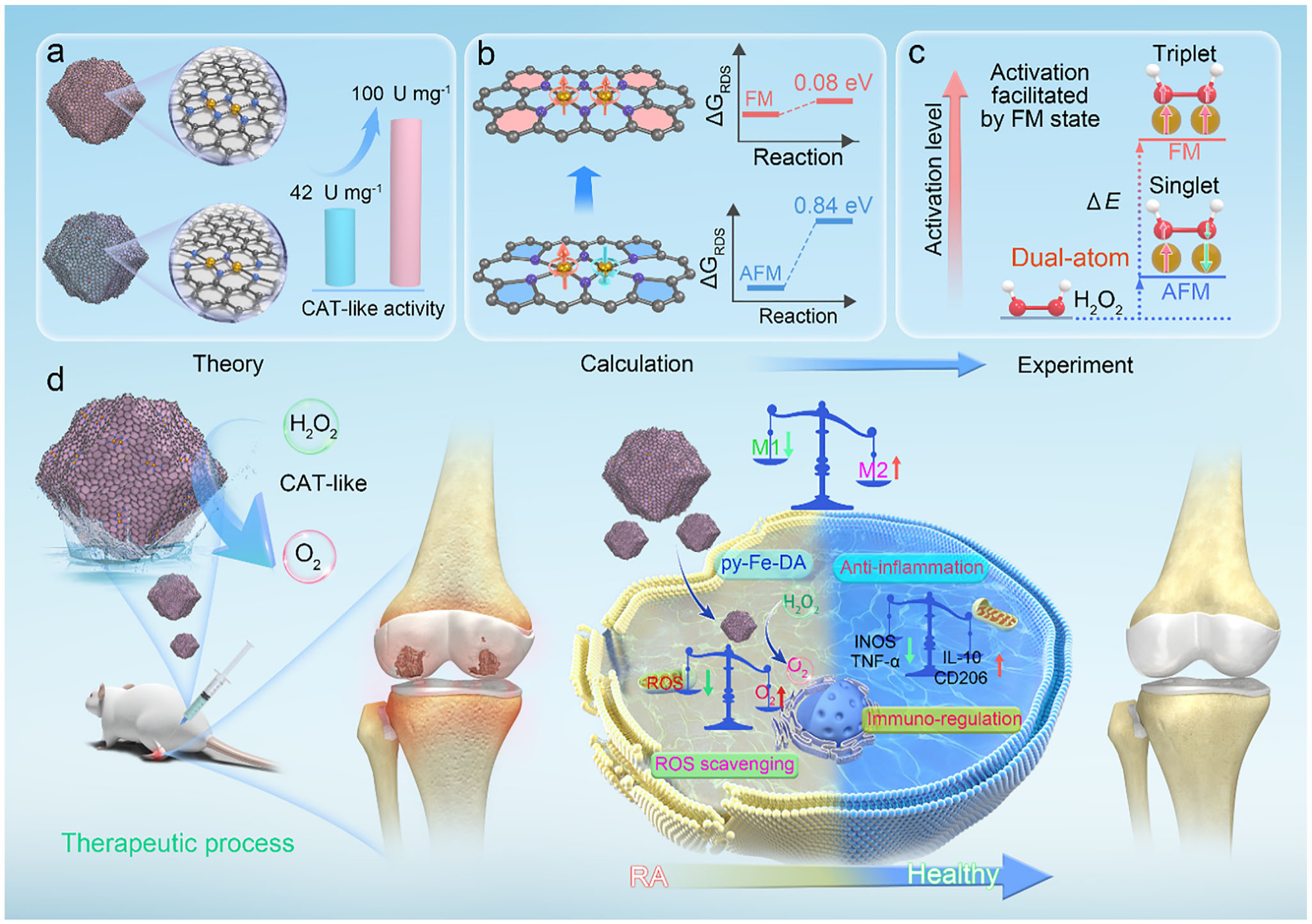
Schematic diagram of spin-regulated catalase-like catalysis of py-Fe-DA for rheumatoid arthritis therapy (Image by MENG Xiang)