Recently, a joint research team led by Assoc. Prof. LI Danfeng from City University of Hong Kong, Acad. XUE Qikun and Assoc. Prof. CHEN Zhuoyu from Southern University of Science and Technology, along with Assoc. Prof. WANG Heng, utilized the Steady High Magnetic Field Facility (SHMFF) to observe a magnetic-field-induced re-entrant superconducting phase for the first time in europium (Eu)-doped infinite-layer nickelates.
The research results were published in Nature.
In condensed matter physics, external magnetic fields typically destroy superconducting Cooper pairs through orbital and paramagnetic effects. However, under extremely rare circumstances in strongly correlated systems with local magnetic moments, strong magnetic fields can paradoxically induce a suppressed superconducting phase to reappear. Exploring this exotic "re-entrant superconductivity" provides a crucial pathway to understanding the intricate interplay between magnetism and unconventional superconductivity.
In this study, the team investigated the phase diagram of infinite-layer nickelate thin films (Sm0.95-xCa0.05EuxNiO2) by precisely tuning the Eu doping concentration. The experiments were performed using an extreme low-temperature electrical transport system under the 45.22 T hybrid magnet at SHMFF, enabling measurements under ultra-high magnetic fields and ultra-low temperatures.
Under these extreme conditions, the researchers directly observed, for the first time via electrical transport and mutual inductance measurements, an anomalous "superconducting–normal–superconducting" transition in the Eu-rich overdoped regime.
Further studies revealed how magnetic field orientation, temperature, and Eu doping jointly influence the stability of this newly discovered high-field re-entrant superconducting phase. The re-entrant superconducting state emerges after the initial suppression of low-field superconductivity and is confirmed by both zero-resistance transport and high-field diamagnetic screening. Remarkably, this phase exhibits strong angular robustness, persisting across the full 0°–90° range of magnetic field orientation.
The results also show that the classic Jaccarino–Peter compensation mechanism alone cannot fully explain the behavior at the highest doping levels, suggesting the possible involvement of unconventional magnetically mediated pairing. In addition, pronounced nonlinear Hall effects and hysteretic magnetoresistance in the normal state further indicate complex intertwined magnetic and electronic interactions.
"This work establishes infinite-layer nickelates as a unique platform bringing together concepts from high-temperature and heavy-fermion superconductivity, opening up new ways to explore and create unusual quantum states in strongly correlated materials.” said Assoc. Prof. WANG Heng.
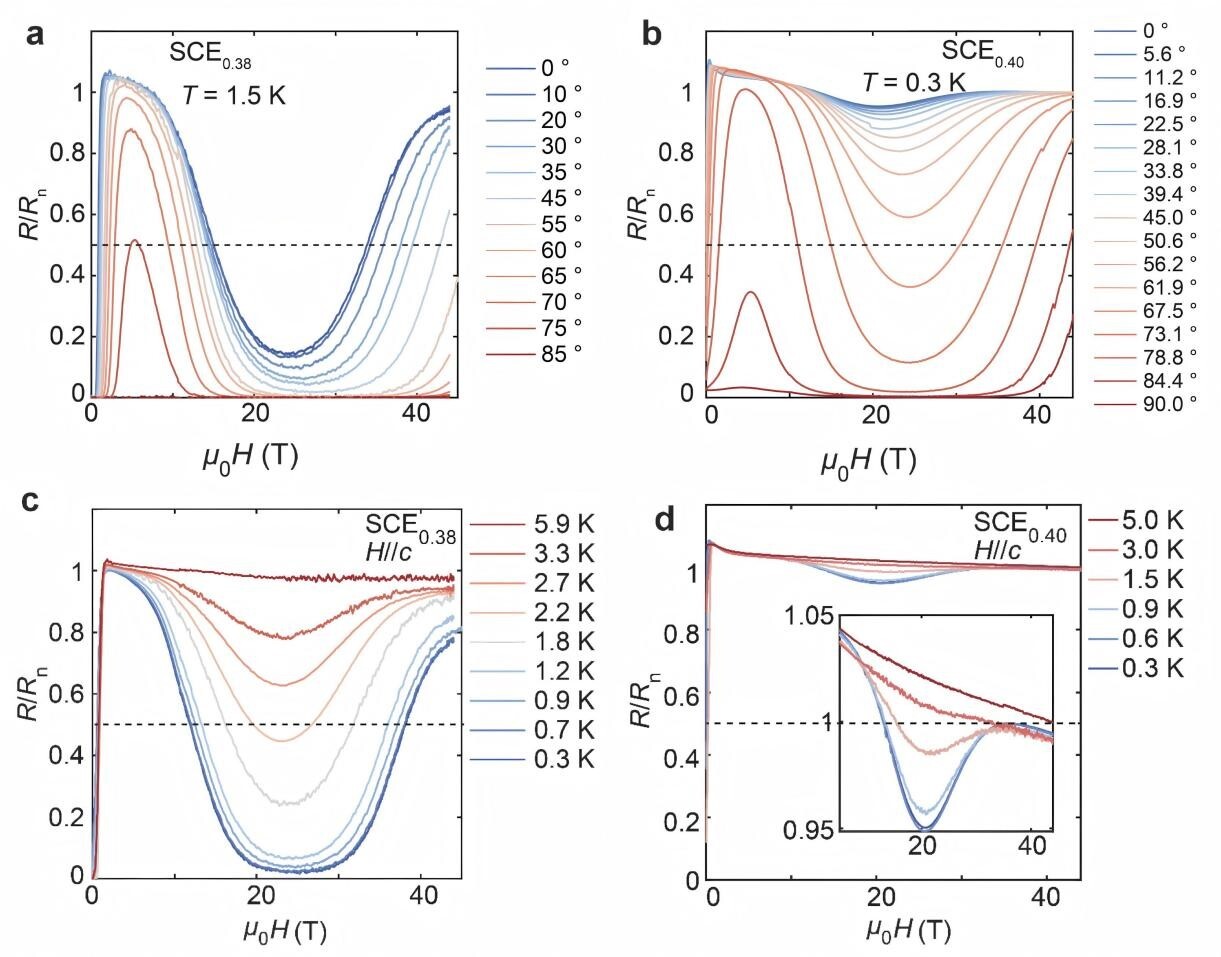
Extreme low-temperature rotational electrical transport test results under the 45 T hybrid magnet: Normalized resistance curves of highly Eu-doped SCE0.38 and SCE0.40 samples at a base temperature of 0.3 K under various magnetic field angles.(Image by MENG Wenjie)